


Degenerative Disc Disease

Degenerative disc disease is a common condition affecting both men and women equally, where the discs located between the bones in our spine begin to wear down overtime and can result in pain in your lower back, buttocks and even your thighs.
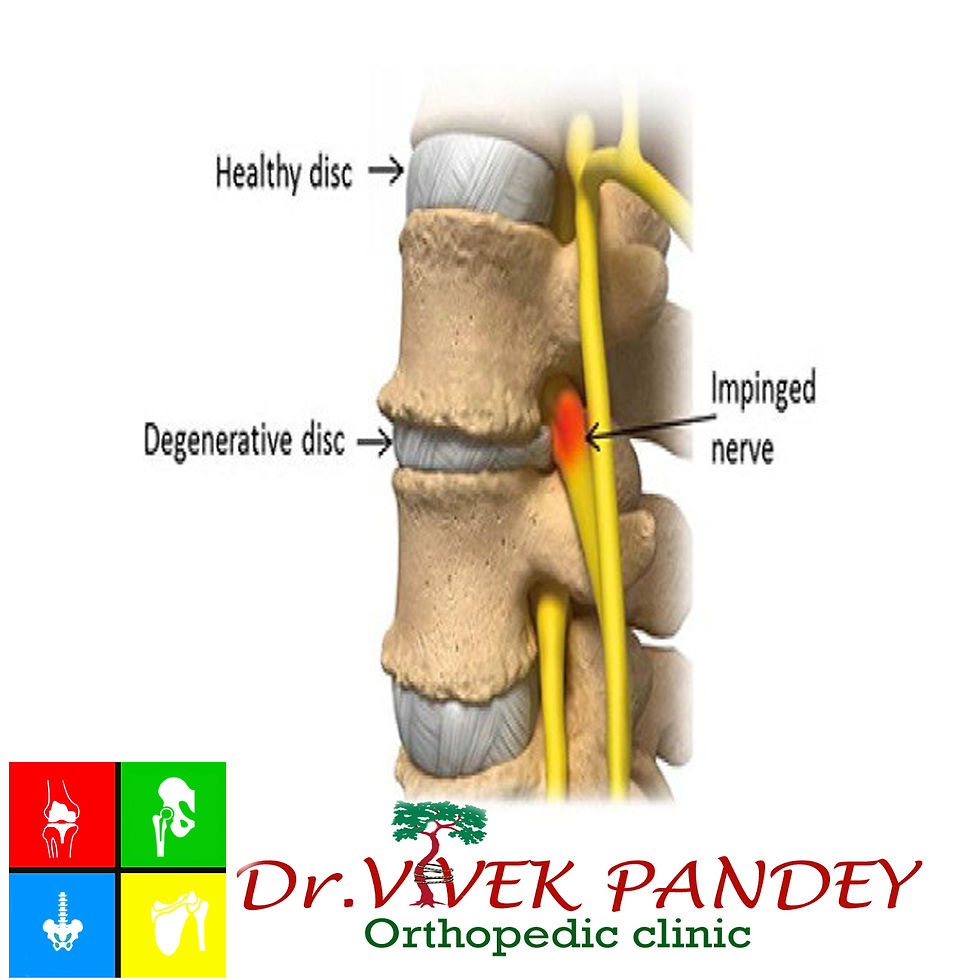
Our backbone or “spine” is made up of small bones called “vertebrae” which are stacked on top of one another. Between each of these bones is a small cushion known as the “intervertebral disc" act like shock absorbers .Their main function is to help your back flexible, in order to bend and twist. As you age, these discs can show signs of wear and tear by beginning to break down and might not work as they used to.

CAUSE OF DEGENERATIVE DISC DISEASE
Dryness: Your disc is predominantly made of water. With aging they eventually lose the water and get thinner. As the discs lose water and get flatter they are not able to absorb shocks as they used to. Due to the water loss, this cushion of protection is lost which can lead to problems in your spine that might cause pain.
Tear: Everyday stress and various other injuries over the years to the spine can cause tiny tears in the outer wall of the discs, which contains nerves. The tears near the nerves can get painful.
SYMPTOMS OF DEGENERATIVE DISC DISEASE:
If you are suffering from a sharp or constant pain in your back and neck. Your symptoms depend on where the weak disk is and other changes it has caused.
• Pain is typically described as an “aching” sensation
• Increased pain with bending, twisting or lifting motions of the low back
• Increased pain from prolonged positions such as sitting or standing (low back) and looking down for too long (neck)
• Pain typically decreases with changing positions and stretching regularly
• Decreased pain with certain positions such as lying down and/or reclining in a chair
• Muscle tightness and spasm surrounding the low back or neck
• Radiating pain traveling from the neck into the shoulder, arm, or hand (i.e. cervical radiculopathy) or from the low back into the hips, buttocks, or down the leg (i.e. lumbar radiculopathy)
• More severe symptoms can include numbness or tingling that radiates into the extremities
TREATING DEGENERATIVE DISC DISEASE:
Medication: Medications like NSAIDS which help reduce the inflammation. However, any kind of medication should be taken by prescription after consulting with your doctor.
Physical therapy: Specific exercises suggested by your doctor can make the muscles in your neck and back flexible and stronger as well and this in turn supports the spine.
Steroid shots: These have strong medications to ease pain, swelling, and inflammation. Your doctor may suggest you get a shot in the epidural space in your back, a fluid-filled area around the spinal cord, or get one in your nerve or muscle.
Surgery: If either of these treatments don’t work, your doctor might resort to surgery as the last option of treatment.
For more information, you can contact:
drvivekpandey@hotmail.com
Comments