


Tennis Elbow (Lateral Epicondylitis) An Overview
Tennis elbow, or lateral epicondylitis, is a painful condition of the elbow caused by overuse.
Not surprisingly, playing tennis or other racquet sports can cause this condition. However, several other sports and activities can also put you at risk.
Tennis elbow is an inflammation of the tendons that join the forearm muscles on the outside of the elbow. The forearm muscles and tendons become damaged from overuse — repeating the same motions again and again.
This leads to pain and tenderness on the outside of the elbow.
CAUSES
Overuse
The extensor carpi radialis brevis (ECRB) muscle helps stabilize the wrist when the elbow is straight. This occurs during a tennis ground stroke, for example. When the ECRB is weakened from overuse, microscopic tears form in the tendon where it attaches to the lateral epicondyle. This leads to inflammation and pain.
The ECRB may also be at increased risk for damage because of its position. As the elbow bends and straightens, the muscle rubs against bony bumps. This can cause gradual wear and tear of the muscle over time.
Activities
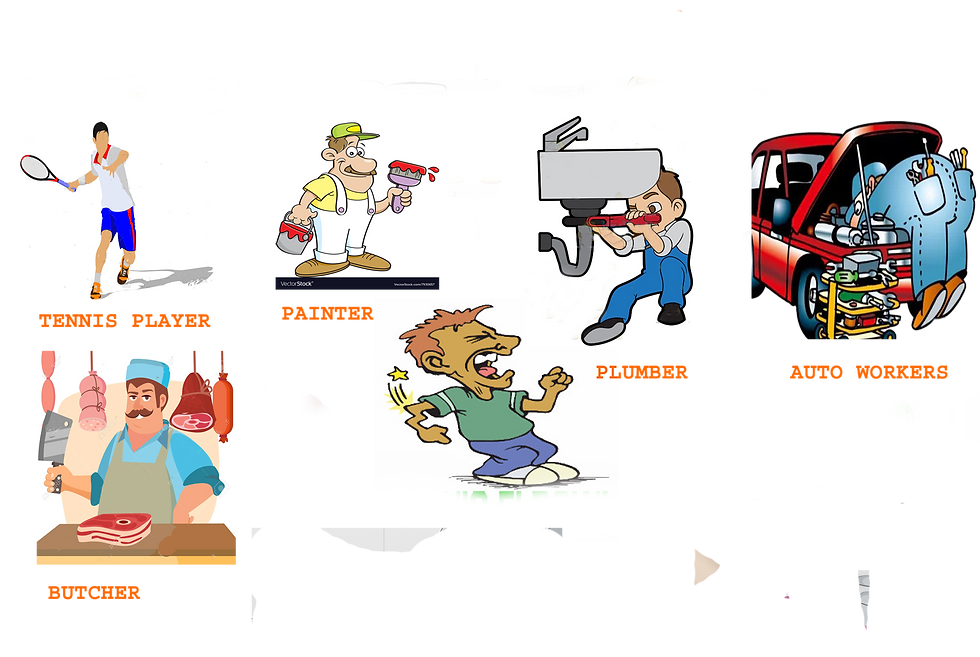
Athletes,Painters, plumbers, carpenters, auto workers, cooks and butchers are particularly prone to developing tennis elbow. It is thought that the repetition and weight lifting required in these occupations leads to injury.
Age
Most people who get tennis elbow are between the ages of 30 and 50, although anyone can get tennis elbow if they have the risk factors.
Unknown
Lateral epicondylitis can occur without any recognized repetitive injury.
SYMPTOMS
Location of pain in lateral epicondylitis.
The symptoms of tennis elbow develop gradually. In most cases, the pain begins as mild and slowly worsens over weeks and months.
Common signs and symptoms of tennis elbow include:
Pain on the outer part of your elbow
Weak grip strength
The symptoms are often worsened with forearm activity, such as holding a racquet, turning a wrench, or shaking hands.
EXAMINATION
During the examination, your doctor will use a variety of tests to pinpoint the diagnosis. For example, your doctor may ask you to try to straighten your wrist and fingers against resistance with your arm fully straight to see if this causes pain.

COZEN'S TEST

MILL'S TEST
If the tests are positive, it tells your doctor that those muscles may not be healthy.
TESTS
Your doctor may recommend additional tests to rule out other causes of your problem.
X-rays. These tests provide clear images of dense structures like bone. They may be taken to rule out arthritis of the elbow.
Magnetic resonance imaging (MRI) scan. If your doctor thinks your symptoms are related to a neck problem, an MRI scan may be ordered. MRIs scans show details of soft tissues, and will help your doctor see if you have a possible herniated disk or arthritis in your neck. Both of these conditions often produce arm pain.
Electromyography (EMG). To rule out nerve compression. Many nerves travel around the elbow, and the symptoms of nerve compression are similar to those of tennis elbow.
TREATMENT
Nonsurgical Treatment
Approximately 80% to 95% of patients have success with nonsurgical treatment.
Rest. The first step toward recovery is to give your arm proper rest. This means that you will have to stop participation in sports or heavy work activities for several weeks.
Non-steroidal anti-inflammatory medicines. Drugs like aspirin or ibuprofen reduce pain and swelling.
Exercises
Wrist stretching exercise with elbow extended.
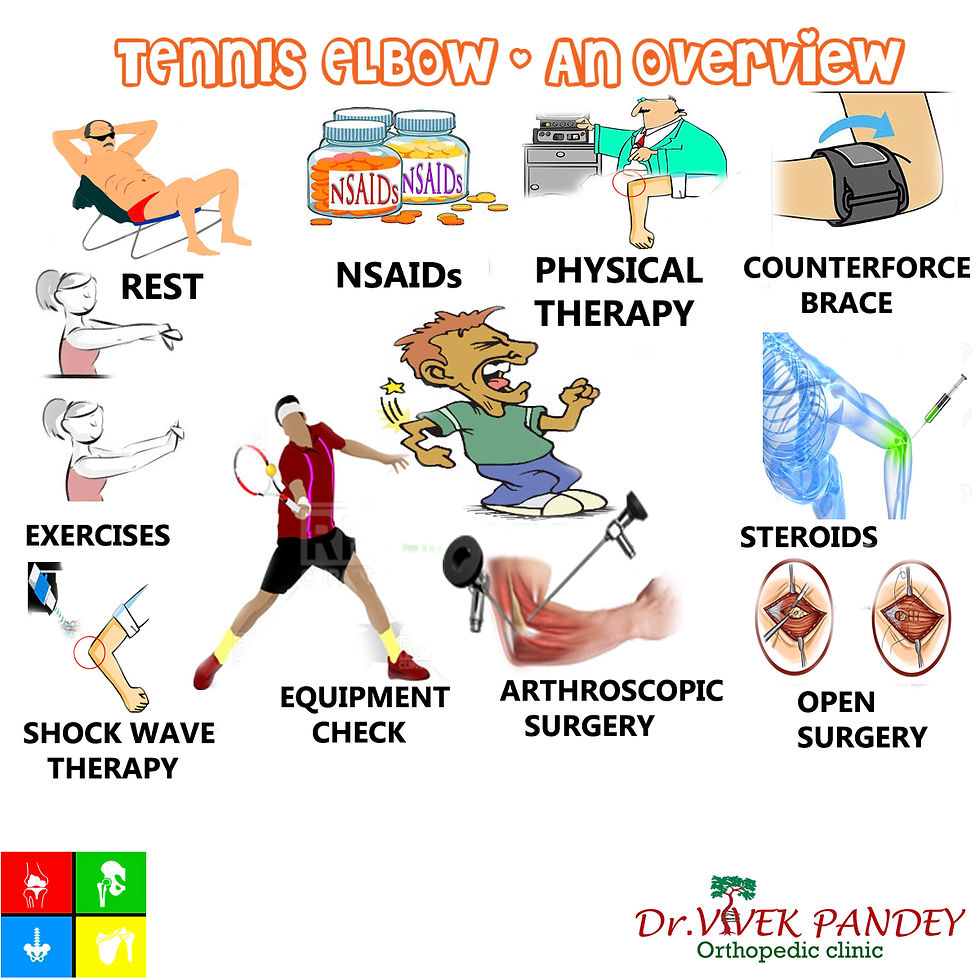
Physical therapy. Specific exercises are helpful for strengthening the muscles of the forearm. Your therapist may also perform ultrasound, ice massage, or muscle-stimulating techniques to improve muscle healing.
Brace. Using a brace centered over the back of your forearm may also help relieve symptoms of tennis elbow. This can reduce symptoms by resting the muscles and tendons.
Steroid injections. Steroids, such as cortisone, are very effective anti-inflammatory medicines. Your doctor may decide to inject your damaged muscle with a steroid to relieve your symptoms.
Extracorporeal shock wave therapy. Shock wave therapy sends sound waves to the elbow. These sound waves create "microtrauma" that promote the body's natural healing processes.
Proper Equipment
If you participate in a racquet sport, your doctor may encourage you to have your equipment checked for proper fit. Stiffer racquets and looser-strung racquets often can reduce the stress on the forearm, which means that the forearm muscles do not have to work as hard.
If you use an oversized racquet, changing to a smaller head may help prevent symptoms from recurring.
SURGERY
If your symptoms do not respond after 6 to 12 months of nonsurgical treatments, your doctor may recommend surgery.
Most surgical procedures for tennis elbow involve removing diseased muscle and reattaching healthy muscle back to bone.
Open surgery. The most common approach to tennis elbow repair is open surgery. This involves making an incision over the elbow.

Open surgery is usually performed as an outpatient surgery. It rarely requires an overnight stay at the hospital.
Arthroscopic surgery. Tennis elbow can also be repaired using miniature instruments and small incisions. Like open surgery, this is a same-day or outpatient procedure.

Rehabilitation. Following surgery, your arm may be immobilized temporarily with a splint. About 1 week later, the sutures and splint are removed.
After the splint is removed, exercises are started to stretch the elbow and restore flexibility. Light, gradual strengthening exercises are started about 2 months after surgery.
Your doctor will tell you when you can return to athletic activity. This is usually 4 to 6 months after surgery.
New Trends
Platelet-rich plasma (PRP) is currently being investigated for its effectiveness in speeding the healing of a variety of tendon injuries.
PRP is a preparation developed from a patient's own blood. It contains a high concentration of proteins called growth factors that are very important in the healing of injuries.
An injection of PRP is used to treat tennis elbow.
Comments